Family Life 1982 – 2000
Lacey, Washington
Mary and I honeymooned in Victoria BC, Canada. We stayed at the The Olde English Inn, which was fantastic, with canopied beds, great food, and a full-scale replica of Anne Hathaway’s (Shakespear’s wife) Cottage in the backyard.
Mary and I decided that I would move into her house and rent my house out. I later sold my house which provided capital for the first of our overseas travel.
Mary’s parents funded annual visits to their home in Tomah, Wisconsin, for which we traveled by train. We always got small private compartments with bunk beds that became seats with a table during the day. We found that a bottle of Bailey’s Irish Cream went well with card-playing during the trips.
Although I had lived in Europe eight years while in the Army, I didn’t have all that much time as a tourist. The first overseas trip Mary & I had was to Europe, starting in Germany. We landed at Frankfurt am Main airport and boarded a train for Erfurt in what had been the garrison location of the Soviet 8th Guards Army and 39th Guards Motorized Infantry Division, which was of significance to me because they were units I kept track of when in the Army. We didn’t go the garrison sites but did see Soviet soldiers sightseeing. The most significant event in Erfurt was visiting a small cafe. We were the first Americans they had seen in person. We were asked to sign a guestbook, had our pictures taken, and were treated like celebrities.
We next took a “milk train” to Kraków , Poland. At first, Mary & I had a compartment by ourselves but were soon joined by aboiut ten polish soldiers in heavy (smelly) overcoats. I was sure I wouldn’t be able to sleep because of the crowding, but I did.
Kraków was interesting. We stayed in an old castle that had been converted to a hotel. Mary & I found ourselves to be the only diners in a very fancy restaurant with about eight waiters in tuxedos standing idle. We later toured the “Kraków Ghetto,” which didn’t look different than other neighborhoods as the walls had long ago disappeared.
We had planned to visit the Auschwitz concentration camp before we began the trip. We took a bus from Kraków to Oświęcim which the Germans called Auschwitz. We didn’t see any information in the Oświęcim bus station so we just started walking toward town. We met a Danish student who spoke perfect English who joined us in looking for the camp. We walked a long way before deciding to chance riding a bus, even though we had no idea where to get off. We noticed signs pointing to a museum and decided to get off the bus. The “museum” signs did indeed take us to the “Arbeiten Macht Frei”(Work Makes Free) sign at the entrance of the concentration camp.
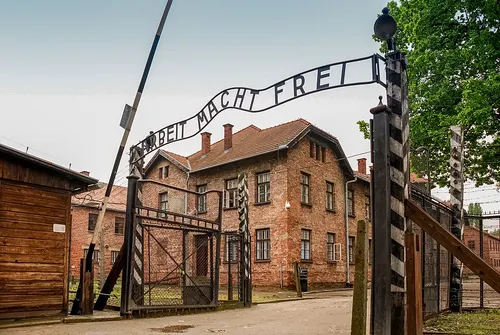
The camp was too shocking to adequately describe our feelings. Sights such as large displays of human hair, eyeglasses, suitcases, and halls lined with pictures of individual inmates are sights we will never forget. Photographs and information can be found here.
At the time of our visit to Auschwitz, local farmers were burning the wheat stubble in their fields. The smoke and ash hanging in the air brought to mind the crematoriums we’d seen in the Auschwitz camp. We couldn’t get out of Poland fast enough! We picked up our stuff and boarded a train to Vienna.